


WDG3000 Extra Strength BTI
WDG3000 Extra Strength BTI
Mosquito larvicide for standing water
Bti larvicide for mosquito larvae in standing water
WDG3000 is a concentrated Bti larvicide. Mix it with water and apply it to standing water. EPA Reg. No. 62637-14.
For standing water sites only. Mix with water and apply as directed on the label. Never apply to treated, finished drinking water reservoirs.
What it is
What WDG3000 is
Bti is short for Bacillus thuringiensis subspecies israelensis. It works on larvae in the water when they eat it. It does not affect adult mosquitoes.
WDG stands for water dispersible granule. It is made by Becker Microbial Products, now part of Clarke, and sold commercially as AquaBac WDG 3000. The other 57% is the carrier that keeps the granules dispersing evenly in the tank.
Where to use it
Also labeled for nuisance aquatic midges in shallow ponds, at a higher rate.
Label
Key label directions
The main label directions, with what each one means in practice.
Apply it only to water sites. Never apply it to a drinking water supply.
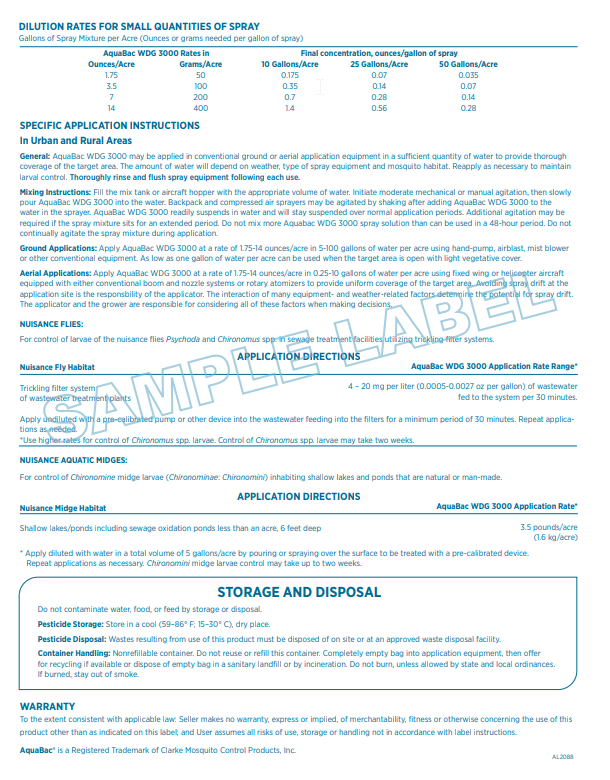
Always mix it with water before applying. An acre of water surface takes 1.75 to 14 ounces.
Older larvae need the higher rate. When larvae are small, the lower rate is enough.
There is no fixed interval. Reapply when larvae show up again.
Keep the bag sealed, cool and dry.
Rates
How much to mix
Mix the powder into 1 gallon of water, then apply that gallon evenly over 1,000 square feet of water surface. Measure the surface area of the water, not its depth or volume.
| What you are treating | Powder per gallon of water | About |
|---|---|---|
| Mosquito larvae, most standing water | 1.1 to 4.6 grams | 1/2 to 2 1/4 teaspoons |
| Mosquito larvae, polluted water | 4.6 to 9.1 grams | 2 1/4 to 4 1/2 teaspoons |
| Aquatic midges, shallow ponds | 36.4 grams | 6 tablespoons |
- Use the low end when larvae are small. Use the high end when most larvae are large.
- Larger areas: mix 1 gallon for every 1,000 square feet. A 3,000 square foot pond takes 3 gallons.
- Smaller areas: mix a full gallon and apply only the share that matches the area. 100 square feet takes about 13 ounces of the mix.
Teaspoon amounts assume about 2 grams per level teaspoon. Granule density varies, so a gram scale is more accurate. Label rates are 1.75 to 7 oz per acre for most mosquito habitats, 7 to 14 oz per acre for polluted water and 3.5 lb per acre for aquatic midges, mixed in 5 to 100 gallons of water per acre. This mixing guide uses about 44 gallons per acre.
Directions
How to apply
FAQ
Common questions
Can I sprinkle the granules straight into the water?
No. The label directs you to mix it into water in a tank with agitation and apply the mix. Dry application is not on the label.
How often do I reapply?
The label says to reapply as necessary to maintain larval control, with no fixed interval. Water that refills or holds runoff will need repeat treatment.
How much does one bag treat?
The 8 oz bag is about 227 grams. At the label's mosquito rates, that covers roughly 1.1 acres of water surface at 7 oz per acre, up to about 4.6 acres at 1.75 oz per acre.
How should I store it?
Sealed, cool, and dry, between 59 and 86 F per the label. When you finish a bag, empty it completely into your mix, then recycle the bag if available or dispose of it in a sanitary landfill.
What if I get it on me?
The label lists it as harmful if inhaled or absorbed through the skin and a moderate eye irritant. If inhaled, move to fresh air. For eyes, rinse with water for 15 to 20 minutes. For skin, remove contaminated clothing and rinse for 15 to 20 minutes. Call a poison control center or doctor for treatment advice, and have the label with you.
Research
Mosquito research
Bti has been used in mosquito control since the late 1970s.
Bti for mosquito control
A review of Bti in mosquito control programs: habitats, formulations, application methods and the factors that affect results in real water.
Lacey, L.A. (2007). Journal of the American Mosquito Control Association 23: 133 to 163. Read it
How Bti works
Larvae eat the protein crystals, their alkaline gut activates the toxins, and the toxins break down the gut wall. Several toxins working together is why field resistance has not been reported after decades of use.
Silva-Filha, M.H.N.L. et al. (2021). Toxins 13(8): 523. Open access. Read it
Documents
Label and documents
Questions about this product? Contact our support team or use the chat.
Always read and follow the complete EPA approved product label. It is a violation of Federal law to use this product in a manner inconsistent with its labeling.


Total items
Product subtotal